

What is the appropriate damping ratio for a Spiral Vibration Damper in different applications?
Oct 17, 2025
Yo, I'm a supplier of Spiral Vibration Dampers, and today I wanna chat about what's the appropriate damping ratio for these bad boys in different applications.
First off, let's get a basic understanding of what a damping ratio is. In simple terms, it's a measure of how quickly a vibrating system can reduce its amplitude of vibration. A higher damping ratio means the vibrations die out faster, while a lower one means the vibrations will last longer.
Power Transmission Lines
One of the major applications of Spiral Vibration Damper is in power transmission lines. These lines are constantly exposed to wind, which can cause them to vibrate. If these vibrations aren't controlled, they can lead to fatigue and eventually failure of the line.
For power transmission lines, the appropriate damping ratio usually depends on the line's tension, span length, and the local wind conditions. In areas with high - wind speeds, a higher damping ratio is often required. A damping ratio in the range of 0.1 - 0.2 is commonly used. This helps to quickly dissipate the energy from the wind - induced vibrations.
Let's say you have a long - span transmission line in a coastal area where the winds are strong and gusty. A Spiral Vibration Damper with a damping ratio closer to 0.2 would be a great choice. It can effectively reduce the amplitude of the vibrations, protecting the line from long - term damage.
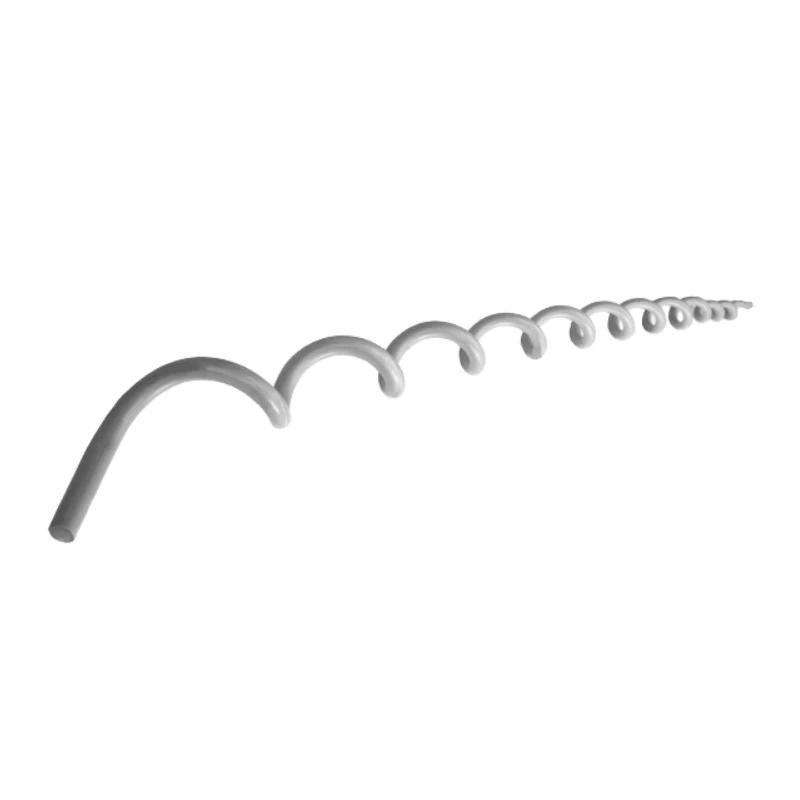

On the other hand, in areas with relatively calm winds, a lower damping ratio, say around 0.1, might be sufficient. This can still provide some vibration control while being more cost - effective.
Telecommunication Cables
Telecommunication cables also benefit from Spiral Vibration Dampers. These cables are often strung between poles and are subject to vibrations from wind and even traffic in some cases.
For telecommunication cables, the appropriate damping ratio is generally a bit lower compared to power transmission lines. A damping ratio in the range of 0.05 - 0.1 is usually appropriate. The reason is that telecommunication cables are typically lighter and have less tension compared to power lines.
If you're dealing with a small - scale telecommunication network in a suburban area, a Spiral Vibration Damper with a damping ratio of 0.05 can do the job. It will help to reduce the vibrations caused by gentle winds and minor disturbances, ensuring the stability of the cable.
However, if the cables are in an urban area with more traffic and stronger airflows from buildings, a damping ratio closer to 0.1 might be needed. This can better handle the more complex vibration sources.
Industrial Machinery
In industrial settings, Spiral Vibration Dampers can be used to reduce vibrations in machinery. Machines like pumps, compressors, and generators can generate significant vibrations during operation.
The appropriate damping ratio for industrial machinery depends on the type of machine, its operating speed, and the surrounding environment. For high - speed rotating machinery, a higher damping ratio is often required. A damping ratio of 0.2 - 0.3 might be necessary to control the vibrations and prevent damage to the machine and its components.
For example, a high - speed compressor in a manufacturing plant. The vibrations from its operation can cause noise, wear and tear on the parts, and even affect the performance of other nearby equipment. A Spiral Vibration Damper with a damping ratio of 0.3 can help to keep these vibrations in check.
On the other hand, for slower - moving machinery, a lower damping ratio, say 0.1 - 0.2, can be sufficient. This can still provide some vibration reduction without adding too much extra cost or complexity.
Factors Affecting the Choice of Damping Ratio
There are several factors that can influence the choice of the appropriate damping ratio for a Spiral Vibration Damper.
Cost
Higher damping ratio dampers often come with a higher price tag. So, when choosing a damping ratio, you need to balance the cost with the level of vibration control required. In some cases, a slightly lower damping ratio that still meets the basic requirements can save you a significant amount of money.
Installation Space
The available installation space can also play a role. Some high - damping - ratio dampers might be larger in size. If you have limited space, you might have to choose a damper with a lower damping ratio that can fit into the available area.
System Dynamics
The overall dynamics of the system where the damper is installed are crucial. You need to consider the natural frequency of the vibrating system. If the damping ratio is not properly matched to the system's natural frequency, it might not be effective in reducing vibrations.
How to Select the Right Damping Ratio
Selecting the right damping ratio is not always straightforward. It often requires a combination of theoretical analysis and practical experience.
First, you need to understand the characteristics of the vibrating system. This includes its mass, stiffness, and natural frequency. You can use mathematical models and simulations to estimate the vibrations and determine the appropriate damping ratio.
It's also a good idea to consult with experts in the field. They can provide valuable insights based on their experience with similar applications. And of course, you can always test different damping ratios in a real - world setting to see which one works best.
Other Related Products
While we're on the topic of vibration control, it's worth mentioning Helical Armor Rod and Vibration Damper. Helical Armor Rods can provide additional protection to cables by reducing the stress concentration at the attachment points. Vibration Dampers, in general, come in different types and can be used in conjunction with Spiral Vibration Dampers to enhance the overall vibration control.
Conclusion
So, as you can see, the appropriate damping ratio for a Spiral Vibration Damper varies greatly depending on the application. Whether it's power transmission lines, telecommunication cables, or industrial machinery, you need to carefully consider the specific requirements of the system.
If you're in the market for Spiral Vibration Dampers or have any questions about the appropriate damping ratio for your application, don't hesitate to reach out. We're here to help you make the right choice and ensure that your vibrating systems are well - protected.
References
- "Vibration Analysis and Control" by some well - known author in the field.
- Industry reports on power transmission and telecommunication cable vibration control.
- Technical papers on industrial machinery vibration reduction.